Aggregates
Oct 3, 2025

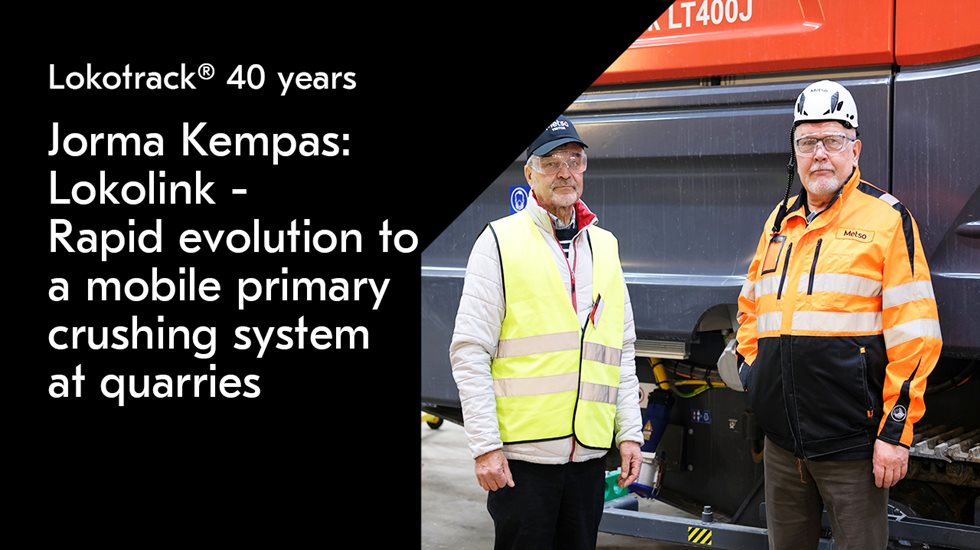
Jorma Kempas reflects on his 38-year career at Metso: How the Lokotrack® Primary Crusher evolved into a mobile crushing system for quarry needs

The launch of the track-mounted Lokotrack® crusher marked the beginning of a transformation in quarry operations. In just two years, the first mobile in-pit crushing system was developed—bringing crushing closer to the blasted rock and enabling material transport with mobile conveyors. Jorma Kempas had a central role in the development of this system and was involved in nearly every delivery worldwide.
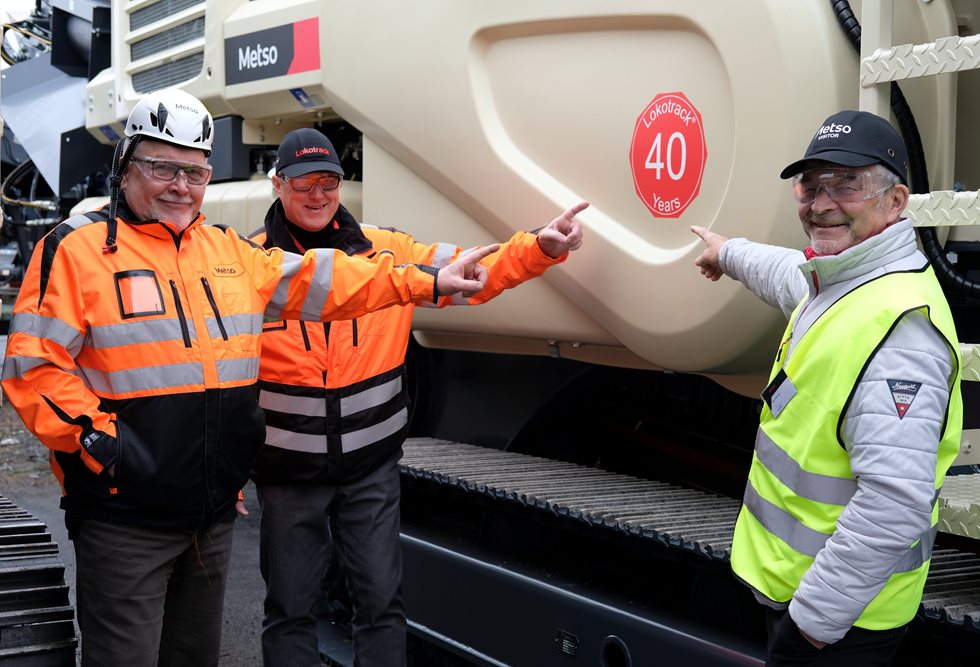
Jorma Kempas exploring the latest-generation diesel-hydraulic Lokotrack LT350C jaw crusher with Kari Rikkonen and Kimmo Antila.
Jorma Kempas (right) exploring the latest-generation diesel-hydraulic Lokotrack LT350C jaw crusher with Kari Rikkonen and Kimmo Antila.

“Just two years after the launch of the track-mounted Lokotrack® crusher, Metso delivered the first mobile in-pit crushing system to a quarry in England. The concept was simple yet groundbreaking: perform primary crushing close to the blasted rock using a Lokotrack crusher, and transport the material onward with mobile conveyors,” describes Jorma Kempas.  

Kempas served as product and proposal manager for Lokotrack crushers and had a central role in this development. Kempas, the “father of in-pit crushing,” was involved in nearly every in-pit delivery worldwide during his 38-year career at Metso and its predecessor companies.

Jorma Kempas
Jorma Kempas is widely recognized for his expertise in developing Metso’s in-pit crushing solutions.

Why choose a mobile crushing and conveying system? 

According to Kempas, the main benefit lies in eliminating 3–5 large haul trucks from the process. This significantly reduces investment, fuel, and maintenance costs. Haul trucks carry not only the rock load but also their own weight, whereas a mobile crushing system enables more cost-efficient loading with an excavator instead of a wheel loader. 

Safety also improves as traffic, noise, and dust are reduced. In many projects, mobile crushing and conveying systems were the only viable option due to strict environmental regulations. 

Check the video

First delivery to England 

The first in-pit system was delivered in 1988 to the ARC Silverdale quarry in England. It consisted of a Lokotrack LT125 jaw crusher and locally manufactured wheeled conveyors. The crushed material was transferred to a fixed field conveyor for further processing. 

Even at this early stage, the Lokotrack in-pit concept proved its value: the crusher and mobile conveyors could flexibly follow the face of the blasted rock. 

During project negotiations, customers highlighted the need for a more integrated solution. Repositioning separate mobile conveyors typically took 30–45 minutes, resulting in 1–1.5 hours of lost production time per shift. To ensure uninterrupted operation, customers preferred a fully integrated system from a single supplier. 

These needs led to the development of the Lokolink conveyor system. Its unique feature is the mechanical coupling between the Lokotrack crusher and the conveyors, allowing daily relocations in just five minutes—dramatically reducing downtime. 

The first Lokotrack-Lokolink system was delivered in 1992 to the Wimpey Pant (later Tarmac Pant) quarry in England. The setup included an LT140 jaw crusher and two Lokolink LL12 conveyors. 

Lokotrack experts Jorma Kempas (left) and Kari Rikkonen at Metso’s Tampere factory.

1,200 tons per hour

One of the longest-running and highest-capacity Lokotrack-Lokolink systems is still in operation at the Tarmac Swinden quarry. Installed 25 years ago, the system includes Metso’s second-largest Lokotrack LT160 jaw crusher and three Lokolink LL16 mobile conveyors. The average capacity is 1,200 tons per hour. 

As environmental regulations tightened and fuel prices rose, interest in in-pit systems grew. Lokotrack-Lokolink systems have since been delivered to around 20 countries, including Germany, Japan, Australia, Thailand, the United States, and Brazil. 

Nearly 60 systems delivered

Over the past 35+ years, Metso and its predecessor companies have delivered nearly 60 Lokotrack-Lokolink systems. Their reliability is reflected in customers who have renewed their in-pit equipment after decades of heavy use. 

Kempas recalls an American quarry manager who summed up the impact of the Lokotrack-Lokolink system: “Trucks are history.” Another memorable comment came from a competitor’s representative, who, upon seeing the system in action, simply said: “We cannot improve that.” 

According to Kempas, Metso’s in-pit solution is suitable for roughly one-third of the world’s medium and large quarries and surface mines. It remains one of Metso’s success stories—with strong demand expected well into the future.
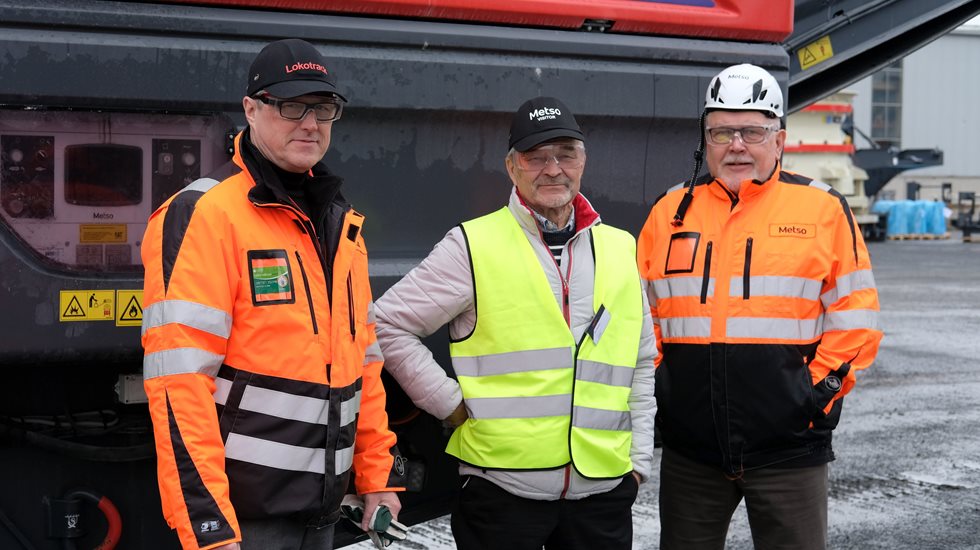
Metso’s 40th anniversary Lokotrack sticker received unanimous approval from Kari Rikkonen (right), Kimmo Antila, and Jorma Kempas.
Aggregates