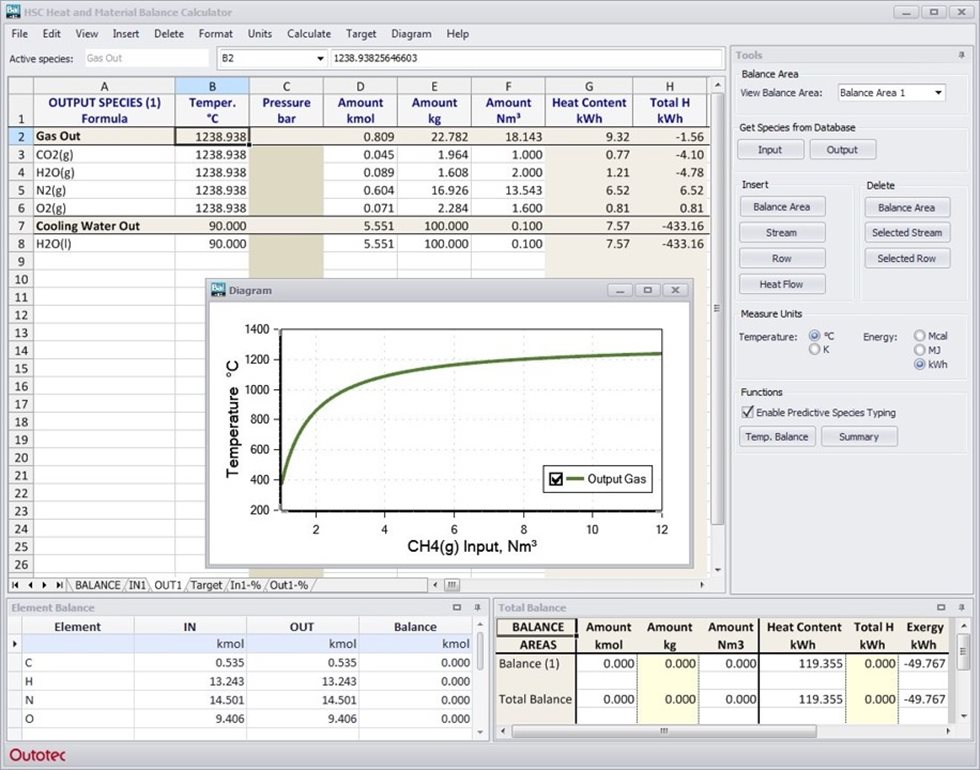
Heat and Material Balances module is a part of the HSC Chemistry software used to carry out thermodynamic and mineral processing calculations.
Heat balance calculations are needed to estimate the energy requirements and the cost of the process, as well as the operation preconditions. In fact, no process will work unless the heat balance is met.
Input and output species, as well as their amounts and temperatures, are needed for the calculations. HSC recalculates the heat balance every time the initial conditions are changed. In this way you can, for example, find the optimal preheating temperature for raw materials to offset the electrical heating of the reactor system.
Theoretical heat balances can be calculated by taking species and amounts from the reaction equations or equilibrium calculations. Real heat balances can be calculated by taking species and amounts from experimental results. These balances are very useful when scaling up processes from laboratory to industrial scale.
By pointing and pressing on the appropriate buttons, the user can select either Celsius or Kelvins for temperature, moles or kilograms for amounts, and calories or joules for energy units.
The Temp. Balance button is used to obtain the product temperature with a zero heat balance. In the case of gaseous combustion processes with zero heat exchange with the environment, this yields the adiabatic flame temperature.
Both input and results can be saved as text files by pressing the Save button. This assures the files will be available later for editing in HSC or use in other programs.