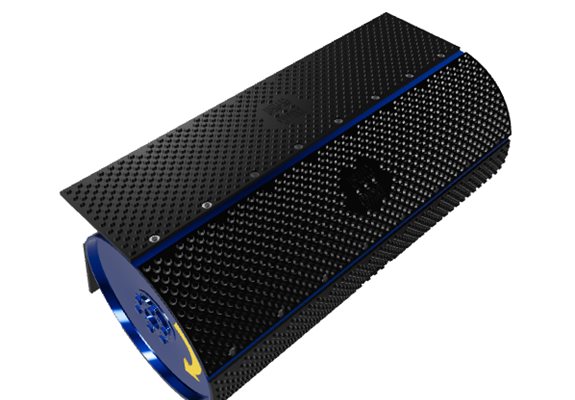
Trellex® Griplag from Metso is a quick replaceable lagging system that has been designed to service a wide range of applications. It is fastened with self-tapping M10 screws directly onto the pulley shell, so it´s easy to install without removing belt or pulley.

Versatility
The most complete product range on the market to maximize output and safety of your conveyor operations.

One-stop partner
Dedicated to keeping your operation as productive and profitable as possible.

Sustainability
Durable conveyor parts designed for long component life.

Reduced downtime
Smart, simple design that makes parts efficient, robust and maintenance friendly.
360°
Trellex Griplag rubber lagging 3D
Installation: Light to medium duty applications
Bolted
Not suitable on reversible belts
Trellex Griplag rubber lagging 3D
Benefits and features
Material: Wear Rubber Trellex T60 ShoreA
Wear side: Conical rubber knobs
Installation: Bolted to pulley surface
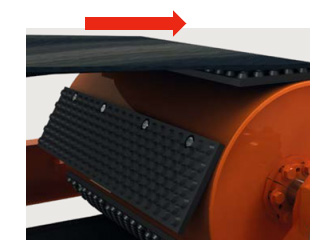
Image: belt direction
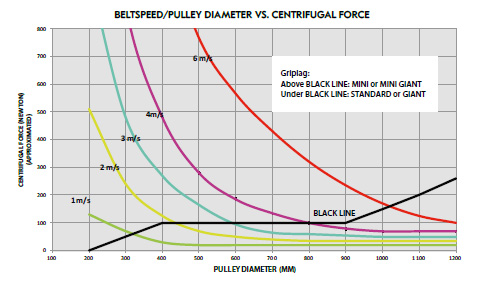
1. You need to know the pulley diameter & belt speed
2. Find the point in the chart where the belt speed curve crosses the line for the pulley diameter.
3. If the point is above the ”BLACK LINE” -> Griplag Mini or Griplag Mini Giant must be used (150mm)
4. If the point is below the ”BLACK LINE” -> Griplag Standard or Griplag Giant must be used (300mm)
Calculate your need:
There are two ways of applying Griplag:
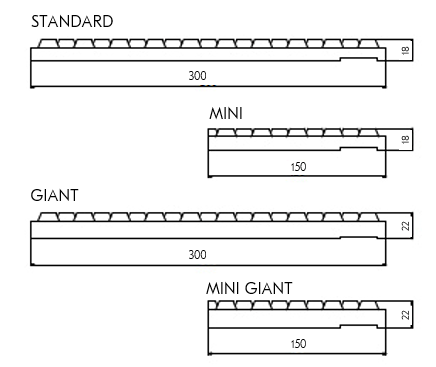
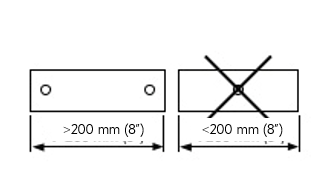
The butt seam method which is the most economic option. Pads are cut to fit the pulley face width and the remaining ends of each cut pad are used butted together. Pieces shorter than 200 mm should be discarded.
The full width method when no butt seams are desired. Each pad row is provided with full face width pads that have no butt seams.
Example pulley diameter 600 mm & face width 1000 mm.
Butt seam method:
1. Number of rows =
pulley diameter x 3,14/300
(300 = 135 mm pad width + 25 mm allowance for retainer.)
x = (600 x 3,14)/300
= 6,28
2. Number of rows =
pulley diameter x 3,14/150
(150 = 135 mm pad width + 25 mm allowance for retainer.)
x = (600 x 3,14)/150
= 12,56
Round down to closest whole number -> 6 and 12.
D = min/max spaces between lagging elements 6-20mm (0.2”-0.8”)
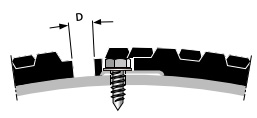
Check spaces between lagging elements
D=(300x0,28)/6 = 14 mm
D = (150x0,56)/12 = 7 mm
2. Multiply the number of rows of pads by the pulley face width, divide with 1200 (full length pad in mm)
(6x1000)/1200 = 5
Round up to closest whole number -> 5 pcs (300 mm) needed
(12x1000)/1200 = 10
10 pcs (150 mm) full length pads needed.
Full width method (only applicable up to face width 1200mm)
1. Same as 1. above
2. Calculate how many full widht sections you can get from a standard size pad.
1200/1000=1,2
Round down to closest full number -> 1
3. Divide number of rows with how many full widths you can get out of one pad.
5/1=5 full length pads required 10/1=10 full length pads required
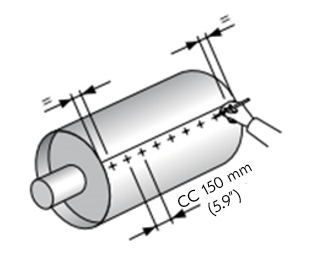
Hole centers in the drum, CC = 150 mm (5.9"):
Hole diameter 9.2 mm (0.36") for M10 self tapping screws: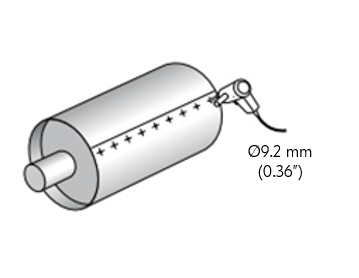
Recommended tightening torque 30 Nm (22 lb/ft):
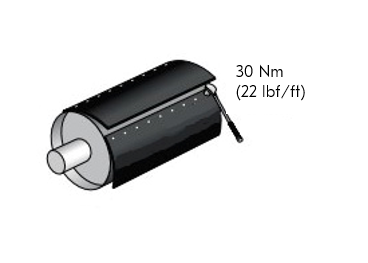
Never install a piece that is shorter than 200 mm (8") and never use fewer than two screws:
Material: Wear Rubber Trellex T60 ShoreA
Wear side: Conical rubber knobs
Installation: Bolted to pulley surface
Image: belt direction
1. You need to know the pulley diameter & belt speed
2. Find the point in the chart where the belt speed curve crosses the line for the pulley diameter.
3. If the point is above the ”BLACK LINE” -> Griplag Mini or Griplag Mini Giant must be used (150mm)
4. If the point is below the ”BLACK LINE” -> Griplag Standard or Griplag Giant must be used (300mm)
Calculate your need:
There are two ways of applying Griplag:
The butt seam method which is the most economic option. Pads are cut to fit the pulley face width and the remaining ends of each cut pad are used butted together. Pieces shorter than 200 mm should be discarded.
The full width method when no butt seams are desired. Each pad row is provided with full face width pads that have no butt seams.
Example pulley diameter 600 mm & face width 1000 mm.
Butt seam method:
1. Number of rows =
pulley diameter x 3,14/300
(300 = 135 mm pad width + 25 mm allowance for retainer.)
x = (600 x 3,14)/300
= 6,28
2. Number of rows =
pulley diameter x 3,14/150
(150 = 135 mm pad width + 25 mm allowance for retainer.)
x = (600 x 3,14)/150
= 12,56
Round down to closest whole number -> 6 and 12.
D = min/max spaces between lagging elements 6-20mm (0.2”-0.8”)
Check spaces between lagging elements
D=(300x0,28)/6 = 14 mm
D = (150x0,56)/12 = 7 mm
2. Multiply the number of rows of pads by the pulley face width, divide with 1200 (full length pad in mm)
(6x1000)/1200 = 5
Round up to closest whole number -> 5 pcs (300 mm) needed
(12x1000)/1200 = 10
10 pcs (150 mm) full length pads needed.
Full width method (only applicable up to face width 1200mm)
1. Same as 1. above
2. Calculate how many full widht sections you can get from a standard size pad.
1200/1000=1,2
Round down to closest full number -> 1
3. Divide number of rows with how many full widths you can get out of one pad.
5/1=5 full length pads required 10/1=10 full length pads required
Hole centers in the drum, CC = 150 mm (5.9"):
Hole diameter 9.2 mm (0.36") for M10 self tapping screws:
Recommended tightening torque 30 Nm (22 lb/ft):
Never install a piece that is shorter than 200 mm (8") and never use fewer than two screws:
Contact local sales experts
Select your industry to open the form.
Your information is safe. Check our privacy notice for more details.
Thank you!
We will shortly contact you. You can send a new inquiry again after 15 minutes.